




Vietnamese Hair vs. Brazilian Hair: The Ultimate B2B Sourcing Guide
For hair salon owners, wig makers, and global extension brands, choosing the right inventory is a critical business decision. For years, terms like "Brazilian Hair" and "Vietnamese Hair" have dominated the market. However, smart wholesale buyers know that sustainable profitability relies on understanding real raw material characteristics rather than relying on surface-level marketing buzzwords. This comprehensive analysis breaks down the true structural, chemical, and supply chain differences between Vietnamese and Brazilian hair, giving you the objective data required to optimize your product lines.
1. Hair Anatomy & Structural Analysis
To understand how extensions perform under daily wear and retail styling, we must analyze the hair shaft from the inside out.
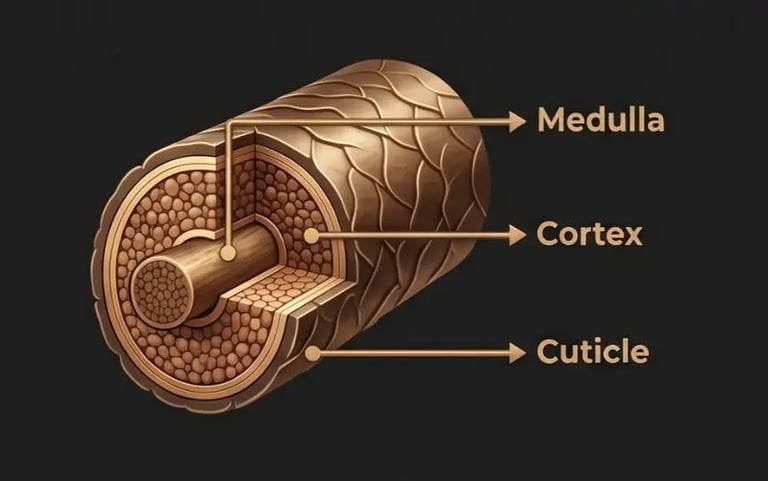
With intact, well-aligned cuticles and a dense cortex, the hair strands are effectively protected against environmental damage such as UV rays, dust, and harmful products.
The Medulla (The Core)
The medulla is the innermost layer of the hair shaft. Vietnamese raw hair features a remarkably thick, continuous medulla. This dense core provides the hair with structural rigidity, making it naturally straight and exceptionally resilient. It is the premier choice for creating flawless, ultra-sleek "Bone-Straight" styles that maintain their crisp finish over time.
In contrast, Brazilian hair generally features a thinner or intermittent medulla. This genetic trait gives the hair a natural flexibility, resulting in a texturized, wavy, or curly pattern. While it may not hold a bone-straight style with the same rigid weight as Vietnamese hair, it excel at maintaining bouncy, voluminous curls.
The Cortex and Melanin Distribution
The cortex forms the bulk of the hair shaft and contains melanin pigments. Vietnamese hair possesses a thicker cortex tightly packed with concentrated black eumelanin. This dense configuration acts as a natural shield against environmental stressors and UV radiation, ensuring the hair maintains its structural integrity.
Brazilian hair typically has a lighter natural pigment base. While this makes it highly receptive to rapid color lifting, it lacks the dense structural protective layer found in true Vietnamese raw hair.
The Cuticle Architecture & Mechanical Durability
The cuticle layer determines the hair's shine, texture, and longevity. Because donors in rural Vietnam traditionally practice low-intervention hair care, the cuticles of raw Vietnamese hair remain remarkably thick, uniform, and fully cuticle-aligned.
Healthy Cuticle Alignment --> Flat, interlocking scales --> Reflects light evenly (High Shine) + Zero tangling
[Damaged/Processed Cuticles] --> Lifted, broken scales --> High friction (Frizz/Tangling) + Low lifespan
This precise cuticle alignment guarantees that the hair retains its natural luster and remains completely tangle-free even after dozens of washes. This structural integrity is one of the main reasons a premier Vietnamese Hair Supplier can command a premium in the luxury boutique space. On the other hand, authentic Brazilian hair frequently exhibits pre-existing styling stress from the donor's personal styling habits, making its cuticle layer thinner, more porous, and more prone to dryness over time.
2. Deep Chemical Resistance: Bleaching and Dyeing Performance
In the luxury B2B market, a hair bundle's value is often determined by its performance in the processing sink. If your customers demand high-lift color transformations (such as Platinum Blonde or Ash tones), chemical resistance is your most critical metric.
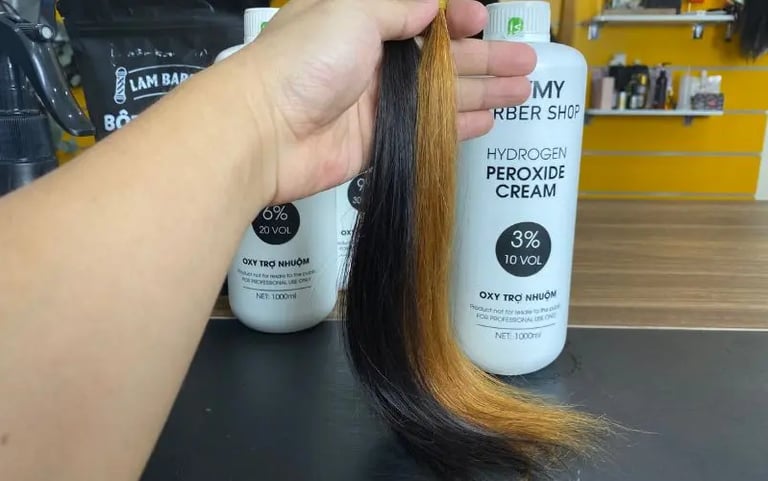
The better the hair structure, the higher its durability after bleaching and dyeing processes.
Vietnamese Hair: Elite Mechanical Endurance
Because of its dense cortex and intact cuticle armor, Vietnamese hair exhibits world-class mechanical strength during chemical processing. While the high concentration of black melanin means it requires a methodical approach to lift, the hair shaft does not degrade easily.
B2B colorists can safely utilize lower-strength developers over extended processing windows to achieve pristine color results without destroying the hair's structural integrity. This exceptional resilience is detailed in our step-by-step processing analysis: Bleaching Experiment: Achieving Level 8 Blonde with 10 Vol (3%) Developer on Vietnamese Raw Hair.
Furthermore, high-grade Vietnamese raw hair can be successfully bleached all the way to a pristine Level 9-10 (613 Blonde). Even at this extreme level of lifting, the strands retain their elasticity and smoothness, completely avoiding the gummy, brittle texture common in lower-quality alternatives.
Brazilian Hair: Fast Lifting with a Lifespan Trade-off
Brazilian hair lifts quickly because its starting pigment base is naturally lighter and more porous. It reaches pale blonde levels with fewer processing cycles, which saves time in production.
However, because the hair shaft is structurally thinner and often carries pre-existing structural wear from the donor, deep bleaching can cause a significant decline in hair health. When lifted to platinum or icy tones, Brazilian hair experiences a faster drop in elasticity, leading to shorter product lifespans and a higher risk of snapping.
3. Cultural Beauty Practices and Hair Wellness Regimens
The premium quality of raw hair extensions begins long before collection. The traditional lifestyles and hair care routines of the donors play a decisive role in the raw material's final grade.
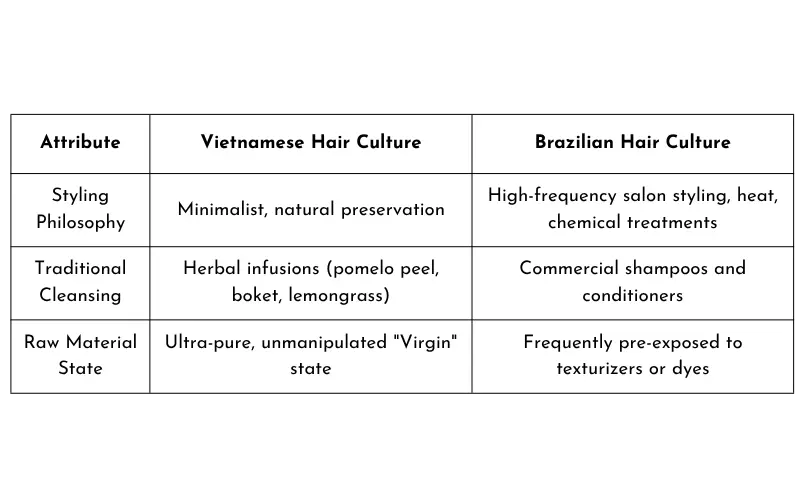
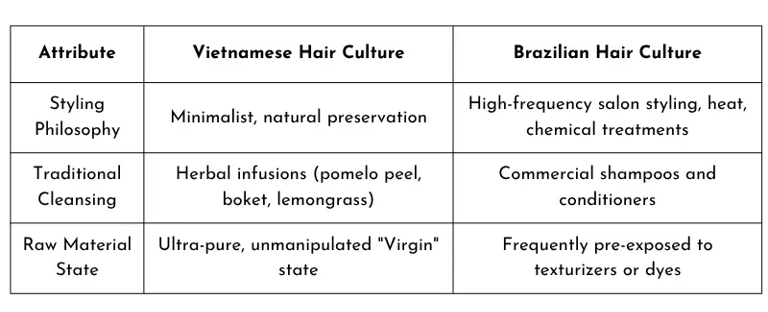
The traditional Vietnamese hair care culture focuses on deep, natural nourishment. Donors frequently cleanse their hair with home-brewed organic mixtures rather than synthetic chemicals. This keeps the hair shafts free from heavy silicone build-up and artificial coatings. This pristine condition explains Why Vietnamese Hair Is Highly Valued in the Global Hair Industry. It provides global manufacturers with a clean, unadulterated canvas for custom manufacturing.
Conversely, Brazil boasts a vibrant, salon-centric beauty culture. Brazilian donors regularly treat, style, blow-dry, and chemically manipulate their hair. As a result, finding completely raw, uncompromised virgin hair within domestic Brazilian markets has become exceptionally rare.
4. Climate and Environmental Factors
The environmental conditions of a donor's geographic region directly influence the physical development of the hair follicle.
Vietnam: The country’s distinct tropical/subtropical climate features consistently high ambient humidity levels. This environment acts as a natural humectant for the hair while it is growing, keeping the strands deeply hydrated. This constant moisture retention prevents structural dehydration and significantly reduces the occurrence of split ends.
Brazil: While also tropical, Brazil experiences highly varied regional climates, including intense dry heat and prolonged sun exposure. This environmental exposure can leave the raw hair material naturally more porous and prone to moisture loss, which can accelerate frizzing once the hair is processed into extensions.
5. Commercial Supply Chains: Market Realities vs. Marketing Mythos
For international B2B buyers, transparent supply chains are vital for maintaining consistent quality and protecting profit margins. The commercial realities of these two origins are starkly different.
The "Brazilian Hair" Marketing Label
The global hair industry experienced a massive wave of "Brazilian Hair" marketing over a decade ago. Due to overwhelming global demand, authentic domestic supply in Brazil was quickly exhausted.
Today, the vast majority of commercial hair labeled as "Brazilian" on the international market is not from Brazil at all. It is typically cheap, low-grade hair sourced from other Asian countries that has been chemically acid-washed to strip the cuticles, coated in heavy silicone for temporary shine, and steam-textured to mimic a natural wave. For serious B2B brands, this lack of traceability introduces massive quality control risks.
The True Vietnamese Supply Chain
In contrast, the Vietnamese hair industry is built on transparent, direct-sourcing networks. Collectors travel directly to rural and mountainous regions to source hair directly from donors.
This direct-sourcing model enables the commercial availability of genuine Single Donor bundles—where an entire bundle or piece is cut from one individual. This guarantees absolute uniformity in cuticle orientation, texture, and chemical behavior.
Final Strategic Sourcing Recommendations
When building your brand's catalog, your choice should align with your core target audience's needs:
Select Vietnamese Raw Hair if your brand focuses on high-end luxury products, ultra-sleek bone-straight extensions, or premium colored lines (like 613 blondes and custom balayages) that require a long lifespan.
Select genuine Brazilian Hair if you are specifically looking for soft, lightweight natural waves and curls, and your client base prefers immediate styling flexibility over maximum structural longevity.
To protect your investment from counterfeit materials, it is critical to thoroughly vet your production partners. Learn how to verify your supply chain with our executive guide on 3 Key Criteria to Identify a Trustworthy Vietnamese Hair Supplier.

Vietnamese Human Hair Supplier | Wigs & Hair Extensions Wholesale
© 2023. All rights reserved.
Bac Ninh Provine, Vietnam - 92 Le Quang Dao Street, Tu Son Ward
Social Media
Quick Links

Whatsapp: +84 911 59 59 88
Products
Support